Media teams write and fact-check a script, render it with a synthetic presenter and cloned or stock voice, then publish with a visible on-screen AI label, provenance metadata and a named human editor who signed off.
What an AI news anchor generator actually is (and what it is not)
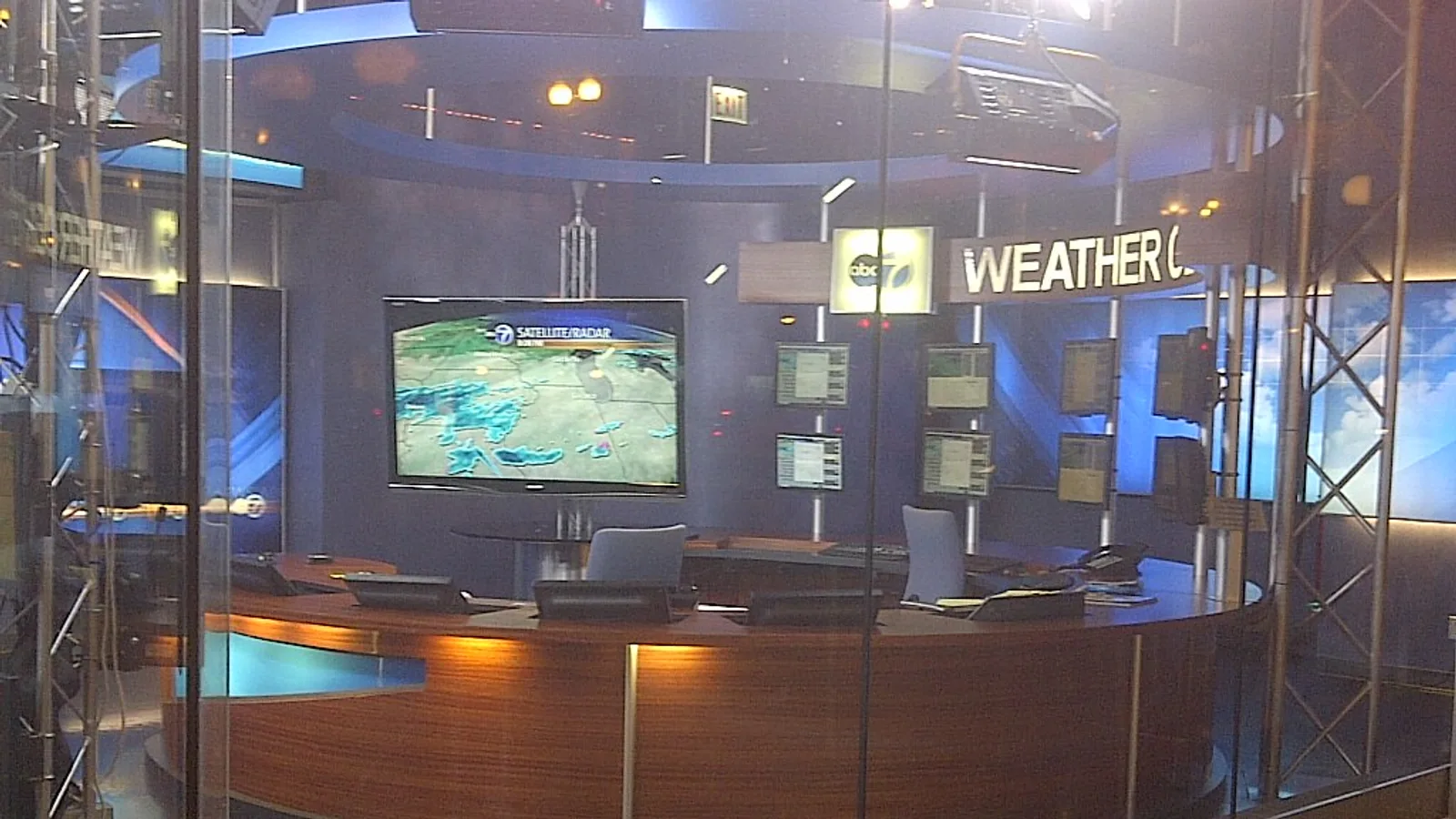
An AI news anchor generator takes a typed script and renders a video of a synthetic presenter reading it to camera, with matched lip movement, a studio-style backdrop and either a stock voice or a cloned one. You type. It renders. The file lands in your CMS without a camera ever being switched on.
The category covers three different things that often get confused, so separate them before you buy anything:
- Stock avatar presenter — a licensed synthetic person from the vendor’s library, used by many customers.
- Custom avatar — a model trained on footage of your own anchor, with that anchor’s written consent.
- Interactive or live avatar — a presenter that responds in real time, usually priced and metered separately from rendered video.
What the tool is not: a journalist. It does not call a source, sit through a planning committee meeting, or notice that a number in paragraph four contradicts the headline. It reproduces your desk’s work at a steady, confident cadence, including the errors.
Audience resistance is the part most teams underestimate. Nieman Lab reported that using AI to create an artificial presenter or author is one of the least accepted newsroom uses of generative AI, with just 19% of respondents across countries comfortable with it, and 20% in the US.
The scenario: a 12-person regional news site that needs a nightly 90-second bulletin
Picture a regional news site with twelve staff: one editor, five reporters, two subs, a social producer, a sales pair and a part-time developer. No camera operator. No studio. The homepage still needs a nightly 90-second bulletin, because the sales team sold a pre-roll sponsorship against it.
The pressure behind that decision is format, not fashion. According to the Reuters Institute Digital News Report 2026, 77 percent of respondents watch online news video weekly, and online news video beats broadcast TV news in 45 of 48 markets.
The desk’s constraint is the 6 p.m. council vote. A bulletin recorded at 4 p.m. is stale by the time it publishes, and asking a reporter to re-shoot at 7 p.m. costs an evening nobody has. Script-to-anchor rendering changes the shape of that deadline: the script can close at 6:40 p.m. and the file can be live before 7.
The same desk also serves a Portuguese-speaking neighbourhood that has never had a local video bulletin, because a second-language shoot was never going to happen with twelve people.
Before and after: the old three-person shoot vs. the script-to-anchor workflow
The old nightly routine pulled three people off other work: a reporter to present, a colleague to run the camera and lights, and an editor to cut, grade and caption. Any factual correction after the edit meant setting up again, because you cannot re-read one sentence and match the lighting from forty minutes earlier.
The script-to-anchor version collapses that into one producer plus one editor who signs off. Corrections become text edits followed by a re-render, which is why late-breaking changes stop being a reason to kill the bulletin.
The figures below are illustrative planning estimates for this hypothetical desk, not survey findings — build your own version before you commit:
| Stage (illustrative estimates, not measured data) | Three-person studio shoot | Script-to-anchor workflow |
|---|---|---|
| People involved | 3 (presenter, camera, editor) | 2 (producer, signing editor) |
| Setup and lighting | 25 min | 0 min |
| Record and retakes | 35 min | 6 min render |
| Edit, captions, export | 50 min | 15 min |
| Fix a factual error at 7 p.m. | Full re-shoot | Edit text, re-render |
| Second-language version | Not attempted | Re-render from translated script |
The honest trade-off: you lose the reporter’s presence on camera, and with it the visible signal that a human stood behind the words.
Step by step: building and publishing your first AI anchor bulletin in one afternoon
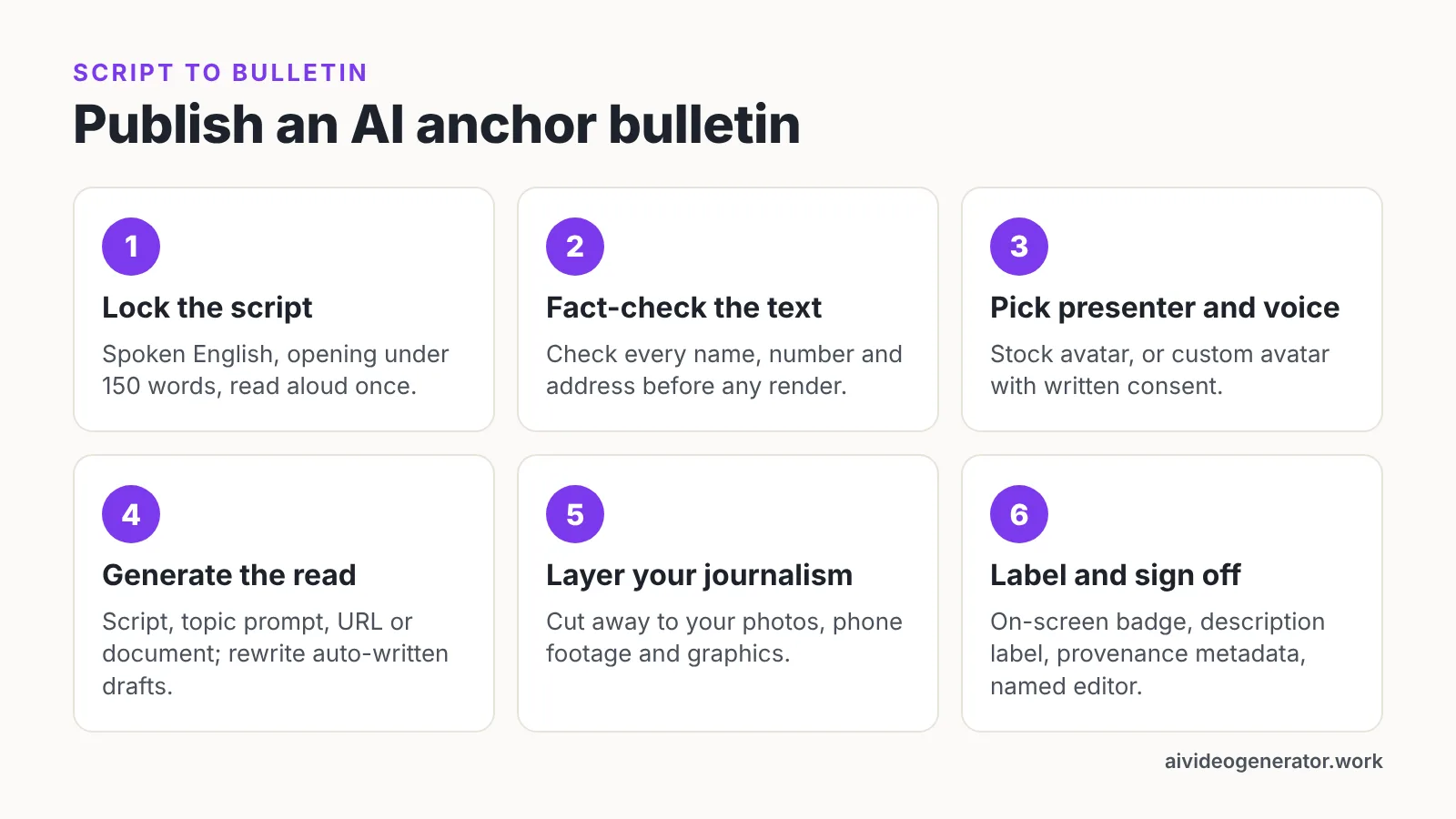
Seven steps, in order, with a signing editor attached to steps one, two and six.
- Lock the script first. Write it as spoken English, keep the opening under 150 words as a working limit, and read it aloud once before anything is generated.
- Fact-check the script, not the video. Every name, number and address gets checked at text stage, because re-rendering is cheap and re-publishing a corrected video is not.
- Choose the presenter and voice. Decide now whether you are using a stock avatar or a custom one built from a consenting staff member. An interactive or live avatar is the wrong tool for a scripted bulletin — it belongs in real-time Q&A formats, not a pre-rendered nightly round-up, and it is usually metered separately.
- Generate the read. Platforms differ in what they accept as input; AI Studios, DeepBrain AI’s cloud platform for avatar video, can build a video from a script, a topic prompt, a web URL, uploaded documents or a product page, and its URL to Video feature summarizes a web page, writes a script and produces a narrated avatar video from it. Treat any auto-written script as a first draft a human rewrites.
- Layer the journalism over the anchor. Cut away to your own photos, phone footage and graphics for most of the duration; the anchor should be the spine, not the whole body.
- Add the disclosure and get sign-off. On-screen label, description label, provenance metadata, named editor.
- Publish, then watch the first comments. Audience reaction to a synthetic presenter is itself editorial feedback.
Where another approach wins: if you already have a reporter who is comfortable on camera and the story is emotional or contested, record the human. A synthetic read of a fatal fire will cost you more trust than the production time saves.
Disclosure and consent: labelling rules, on-screen wording, and provenance metadata
The EU AI Act’s transparency obligations in Article 50, which cover AI-generated and manipulated media, started to apply on 2 August 2026, according to law firm Morgan Lewis. If you publish into the EU, that is the baseline you plan against; other jurisdictions set their own rules, and platform policies add a second layer on top.
Put the label where a scrolling viewer cannot miss it. Three placements, all three used together:
- On-screen, burned in: a persistent corner badge reading AI-generated presenter for the full duration, not a two-second title card.
- In the description and transcript: one plain sentence naming what is synthetic — the presenter and voice — and what is not: the reporting, the script, the footage.
- In the file: provenance metadata attached at export, so the label survives a re-upload.
Consent is separate from disclosure. A custom avatar or cloned voice needs written permission from the person whose face or voice it copies, with a defined scope, an expiry date and a deletion route if they leave.
Provenance tooling is worth checking during procurement. AI Studios lists ISO 27001 certification, SOC 2 Type II compliance and GDPR compliance, and is a member of the Content Authenticity Initiative; confirm how any vendor writes credentials into your actual export, not just what the website says. This is general information, not legal advice — have counsel review your labelling against the rules that apply where you publish.
Scripting and quality control so the anchor does not land in the uncanny valley
Unnatural movement is a measured problem, not a matter of taste. In a 2024 experimental study of adult learners watching an AI-generated synthetic presenter video, published as an arXiv preprint, 24% of participants in one condition reported the AI avatar was distracting or uncomfortable because of unnatural movement.
The fixes are mostly in the writing:
- Write short declarative sentences; long subordinate clauses expose flat prosody.
- Spell numbers as they are spoken, writing decimals and percentages out in words rather than digits.
- Avoid sibilant pile-ups and tongue twisters, which synthetic voices handle poorly.
- Cut interjections, laughter cues and anything implying a gesture the avatar cannot make.
- Keep each avatar shot short before cutting to footage.
Run a three-pass check before publishing. Pass one is audio only, eyes closed, listening for wrong stress and swallowed names. Pass two is video with sound off, watching for dead eyes, stiff hands and a mouth that keeps moving after the line ends.
Pass three is the whole thing at phone size with the sound low, which is how most of your audience will actually see it. If the read survives all three, it ships.
Where AI anchors work, where they fail, and the human-in-the-loop checklist
Reuters Institute research found a large comfort gap: only 12% of respondents were comfortable with fully AI-generated news, versus 62% for entirely human-made content. Those audience findings come from a YouGov survey of 12,000 adults in six countries fielded between 5 June and 15 July 2025, per the Institute for Public Relations.
Reasonable uses
- Scheduled, structured segments: weather roundups, sports results, market closes, transit updates.
- Translated versions of a bulletin your newsroom already published in its main language.
- Evergreen explainers and service journalism that will sit on the site for months.
Do not use a synthetic anchor for
- Breaking news, where errors propagate before anyone can re-render.
- Deaths, disasters and grief, where a synthetic face reads as contempt.
- Investigations and accountability work, where the reporter’s presence is the credibility.
- Interviews, reaction and anything requiring an unscripted response.
Human-in-the-loop checklist
Name a person for each line, not a team: script writer, fact-checker, disclosure reviewer, final signing editor, and the person who pulls the video if a correction lands after publication.
Costs, limits, and how to decide if an AI anchor is worth it for your newsroom
Subscription cost is the smallest number in this decision. Governance time, consent paperwork and the trust you spend are the real line items, and the German findings of the Digital News Report 2025 from Leibniz-Institut für Medienforschung show why: fifty-four percent of respondents there said they feel somewhat or very uncomfortable with news produced primarily by AI.
Plan limits decide more than price. Taking AI Studios as one worked example, it offers more than 1,000 AI voices across its plans, with text-to-speech voiceovers in 150+ languages and accents on paid plans and 30+ languages on the Free plan — a real constraint if you test on Free and your target community’s language sits outside that smaller set. Other specifics to check against your nightly runtime and workflow:
- Unlimited video duration, unlimited custom avatars, SAML SSO, SCORM export and bulk generation sit on the Enterprise plan, which uses custom pricing.
- Interactive (live) avatars are priced separately, with a Free tier of 2 credits and a Standard tier at $99 per month for 100 credits, billed at 1 credit per 5 minutes.
- Voice cloning builds a custom AI voice from a short voice recording, and Docs to Video accepts .ppt, .pptx, .pdf, .doc, .docx, .xlsx and .txt files up to 20 MB, with PPT or PDF imports turning each slide into a video scene.
Other avatar platforms cover similar ground, so shortlist two or three and compare them on how provenance credentials survive your actual export, not on feature counts alone.
Decide yes if your bulletin is structured, your corrections are frequent, and you need language versions you cannot staff. Decide no if the segment depends on a named reporter being visibly present, or if your audience already distrusts the brand. A cheaper middle path exists: keep a human voiceover over stills and footage, and skip the synthetic face entirely.
Frequently asked questions
Do I legally have to label an AI news anchor video?
If you publish into the EU, plan around Article 50 of the EU AI Act: its transparency obligations covering AI-generated and manipulated media started to apply on 2 August 2026, according to Morgan Lewis. Other jurisdictions and platforms set separate rules, so check both. This is general information, not legal advice.
Will readers reject a synthetic presenter outright?
A large share are uneasy. Nieman Lab reported that just 19% of respondents across countries, and 20% in the US, are comfortable with AI used to create an artificial presenter or author. Clear labelling, a named signing editor and human reporting behind the script reduce the damage, but they do not erase it.
How long should a first AI anchor bulletin be?
Keep it tight — roughly 90 seconds for a nightly round-up, with the anchor on screen for only part of that and your own footage carrying the rest. Treat that as production advice rather than a research finding, and test two lengths against your own completion rates before standardising.
Can I clone our existing anchor’s face and voice instead of using a stock avatar?
Yes, on platforms that support it — AI Studios supports voice cloning from a short voice recording, and the Enterprise plan adds unlimited custom avatars under custom pricing. Get written consent covering scope, duration and deletion first, and re-confirm it if the person leaves your newsroom.
What is the single biggest quality mistake to avoid?
Unnatural movement that makes viewers uncomfortable. In a 2024 study of adult learners watching an AI-generated synthetic presenter video, 24% of participants in one condition found the avatar distracting or uncomfortable because of unnatural movement — the study measured discomfort with movement, not shot length. Our own editorial judgement, not a research finding: cut away to photos, footage and graphics early and often so the avatar carries less of the screen time.
Sources
- EU AI Act’s Transparency Rules: What Went Into Effect on 2 August? — Morgan Lewis
- Generative AI and News Report 2025 — Reuters Institute for the Study of Journalism
- People are using ChatGPT twice as much as they were last year. They’re still just as skeptical of AI in news. — Nieman Lab
- How Audiences Perceive AI in News and Media — Institute for Public Relations
- Reuters Institute Digital News Report 2025 – Findings for Germany — Leibniz-Institut für Medienforschung (HBI)
- Adult learners recall and recognition performance and affective feedback when learning from an AI-generated synthetic video (arXiv:2412.10384)
- The Reuters Institute Digital News Report 2026 — Edelman (Richard Edelman’s 6 A.M. blog)
Written with AI assistance and fact-checked against the sources cited above before the AI Video Generator Editorial Team published it.